
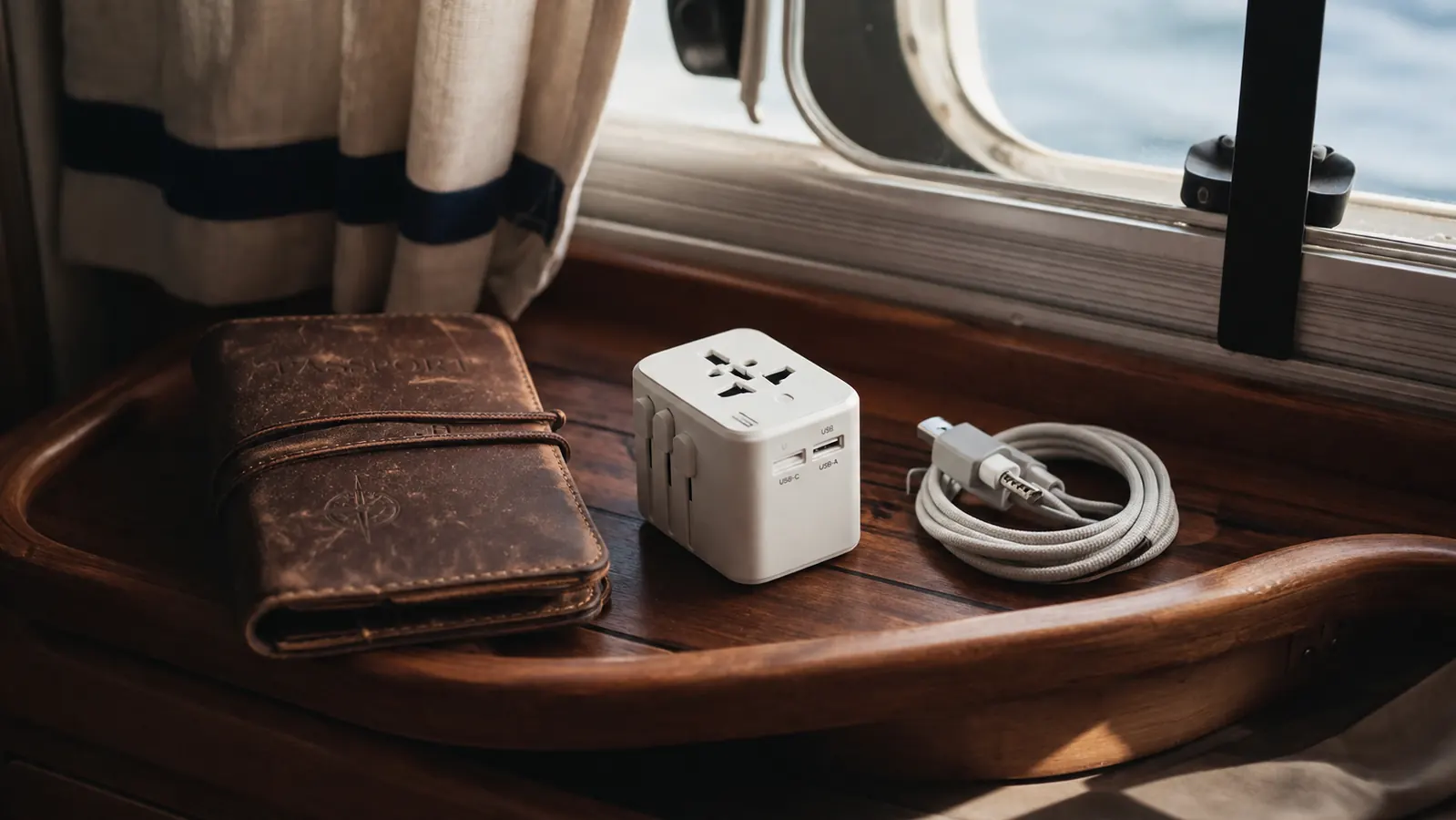
Two years ago I pulled into a marina in Cartagena, Colombia, dead tired after a three-week passage from the Florida Keys. My laptop battery was at four percent. I had a standard US plug on my power brick and the marina outlets were type-B mixed with a handful of European type-C sockets installed by someone who clearly did not care about consistency. I had the EPICKA Universal Travel Adapter clipped to a hook in my nav station and it slid right in without a second thought. That small moment is why this thing has been in my kit ever since.
I am Ray Calloway. I spend roughly six months a year living aboard a 38-foot sloop and the other six riding my BMW GS across the American West and into Mexico. When I travel internationally for longer stretches, compact and tough wins over everything else. I have owned and worn out three other universal adapters in the past decade. The EPICKA is the one I kept.
The Quick Verdict
A genuinely compact, properly built travel adapter that covers 150 countries and charges up to five devices at once. The USB-C port tops out at 5W, which is the only real gripe for two years of daily use.
Amazon Check Today's Price →Your next hotel room will not care about your plug. This adapter does.
The EPICKA covers 150 countries with one click-and-lock slide mechanism. Over 18,000 travelers have reviewed it. Check current availability before your next departure.
Amazon Check Today's Price on Amazon -> →How I Have Used It
My two years with the EPICKA covered three distinct environments: boat marinas in Central America and the Caribbean, budget guesthouses across Spain and Portugal, and a four-week overland trip through Japan that included everything from a Ryokan in Kyoto to a capsule hotel near Shinjuku. Each environment runs different voltages, different socket types, and different levels of electrical consistency. Some of those marina hookups were pushing 130 volts on a good day. Some of the guesthouse outlets in rural Alentejo were barely gripping a plug. The EPICKA handled all of it without tripping a breaker or getting warm to the touch in a way that concerned me.
My typical load: a 13-inch MacBook Air power brick, an iPhone 14, a Garmin GPS chartplotter charger, and sometimes a small LED reading light. On the boat that covers my whole electrical need when I am shore-powered. On the road I can add a Kindle. Four or five devices through one adapter in a marina locker is a real test of whether the thing runs hot, and the EPICKA stayed comfortable in hand after an hour of continuous use. I have also handed it to marina neighbors in a pinch, which happens more than you would think when someone pulls in from offshore and realizes they packed adapters for the wrong destination.
I also keep a second one in my motorcycle top case for domestic and Mexican border crossings, where campgrounds and small posadas use type-A, type-B, and occasionally something I can only describe as improvised. Having the same adapter in both places means I am not hunting for which brick goes with which bag. At the current price, buying two is not a painful decision.
Build Quality and the Plug Mechanism
The first thing I did when I pulled this out of the box was slide every plug type in and out a dozen times. On some adapters that feels like assembling a budget binder. On the EPICKA the slide is firm and clicks into place with a positive detent you can feel without looking. That matters when you are doing it in a dark cabin. After two years of travel the mechanism feels essentially the same. There is no slop in the prongs, and none of them have ever retracted on their own while plugged in, which was a failure mode I hit on a cheaper adapter in Lisbon that kept dropping the connection mid-charge.
The housing is ABS plastic in a white and gray colorway. It is not heavy-duty polycarbonate, but it is not the thin stuff that cracks when you drop it on tile either. I have dropped mine on tile. It survived. The body is about the size of a large ice cube, which is exactly what you want when you are rationing cubic inches in a jacket pocket or a dry bag. The four USB-A ports and one USB-C port are all on top, which means you can keep an eye on connected cables without craning around.
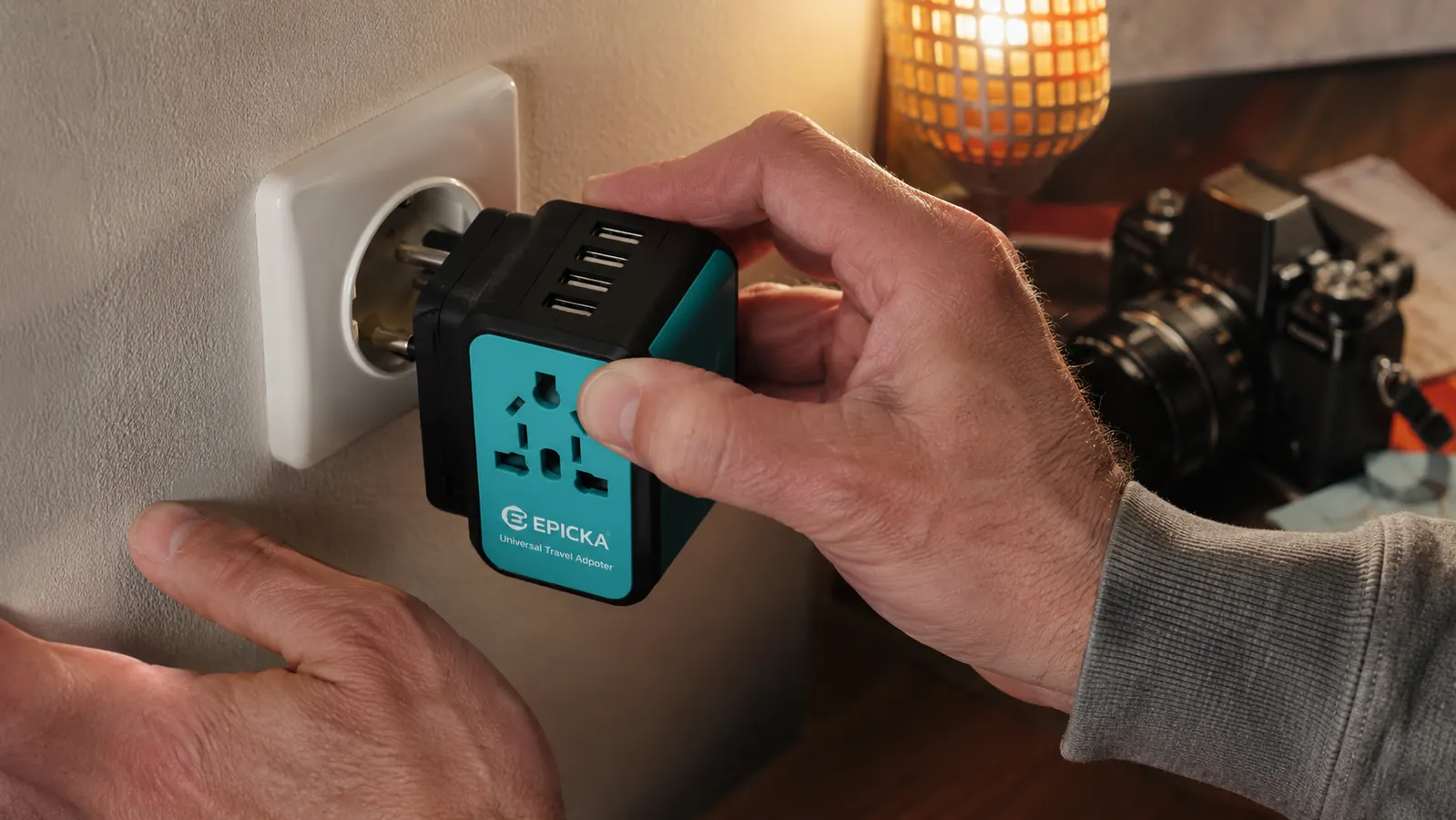
One thing I noticed early on: the adapter has a safety shutter inside each socket that only opens when both conductors of a plug are inserted simultaneously. That is a real feature, not just a bullet point. I have stayed in places where a curious kid or a cleaning person walking through the room is a realistic concern. It does not solve every safety issue but it is better than an open socket with exposed brass contacts.
Charging Speed: What the USB-C Port Actually Delivers
Here is where I have to be straight with you. The EPICKA's USB-C port delivers 5W. That means it can charge a phone slowly or power a small device overnight, but it will not fast-charge a modern smartphone and it will not meaningfully charge a laptop. If you are counting on USB-C to top off a MacBook, you need a wall adapter that delivers 30W or higher and you plug that into the EPICKA's grounded AC socket instead. The EPICKA is the country-converter, not the charger. Use your existing USB-C brick through the AC socket and you are fine.
The four USB-A ports share a combined 2.4A output, which is enough to charge a phone per port in a reasonable time but nothing that will impress anyone with a power-hungry Android flagship. For most travelers with a phone, a Kindle, earbuds, and a small GPS unit, it is plenty. I rarely need all four ports simultaneously, and when I do the device I care least about charging fast gets the USB slot. If you are the kind of person who needs maximum wattage on everything at once, look at a model with USB-C PD of 65W or higher, and expect to pay two or three times more.
Two years in, the plug mechanism still clicks like day one. That is the real benchmark for a travel adapter. Not the spec sheet. The clicks.
Country Coverage in Practice
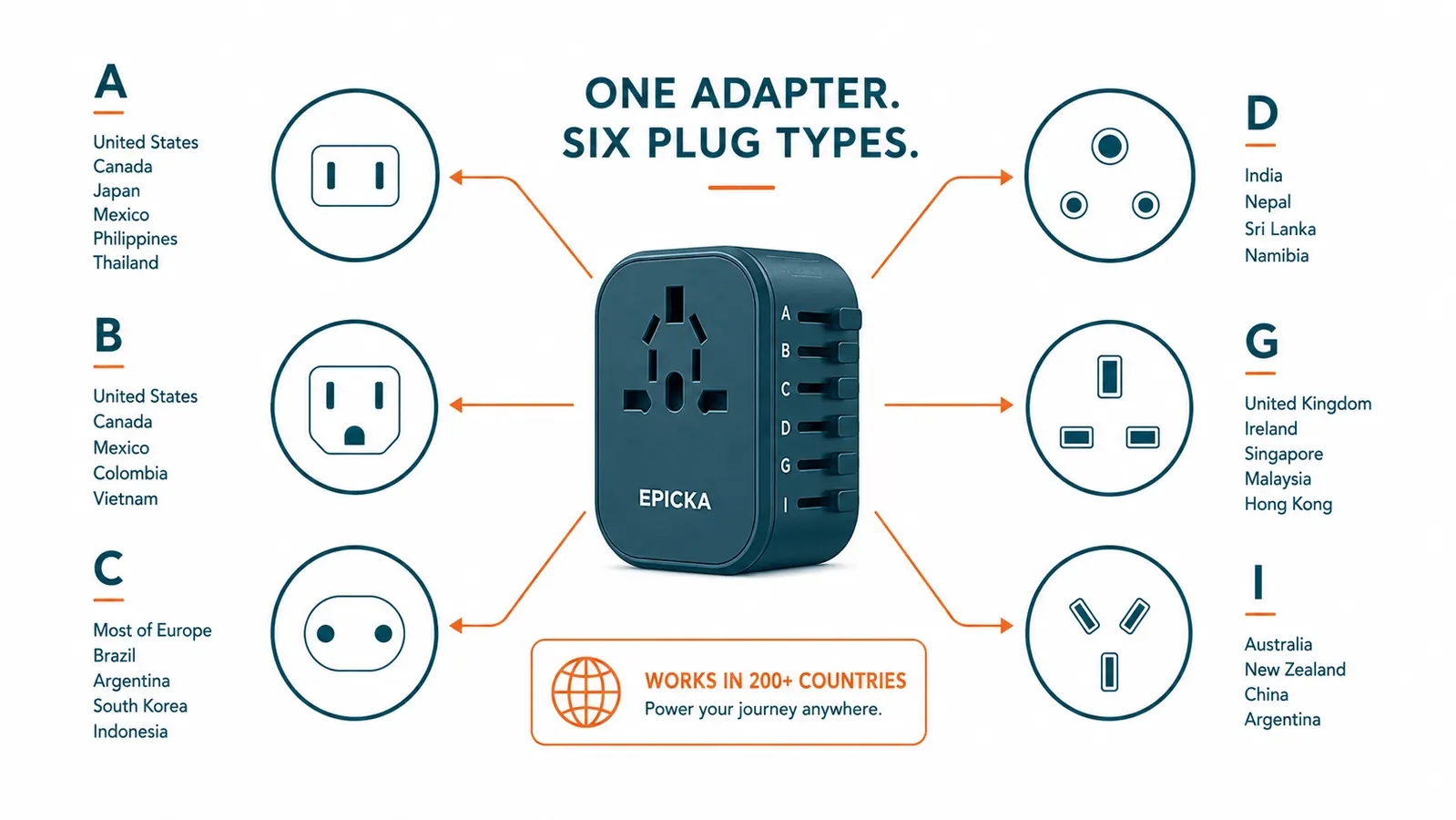
The EPICKA covers type A, B, C, D, F, G, H, I, J, K, L, and N plugs, which maps to over 150 countries in their marketing and is accurate in my experience. Every country I visited in two years of use, including Japan's type-A, the UK's type-G, continental Europe's type-C and type-F, and Costa Rica's mixed type-A and type-B inventory, worked without issue. The one edge case worth flagging: South Africa uses a type-M three-prong plug that the EPICKA does not cover. If South Africa is on your itinerary, you need a separate adapter for that specific socket, or you need to find a type-C secondary outlet in your accommodation, which many newer South African buildings do provide.
For more on how the EPICKA stacks up against another popular option on country coverage and charging specs, see my EPICKA vs TESSAN comparison. And if you want the full case for why a universal adapter beats a pocket full of country-specific adapters, the 10 reasons to use a universal travel adapter piece lays it out clearly.
Heat, Safety, and the Voltage Converter Question
I will admit that for the first few weeks I checked the adapter every hour while charging on the boat. A fire at sea is a categorically different problem than a house fire. The EPICKA never ran more than barely warm in my testing. The maximum rated current is 6A and the maximum power is 1380W at 100 to 240V, which is consistent with its built-in surge protection. I have not personally had it trip on a surge, but I have heard from other sailors who ran into bad shore power and said their EPICKA stopped the damage from reaching their gear. I take that as a good sign, though I would not rely solely on any travel adapter as your surge protection in a seriously unstable grid environment.
What it does not have: a built-in voltage converter. If you have older gear that only runs on 110V, the EPICKA will not save it from a 220V European outlet. Check your device labels for a dual-voltage rating (100-240V) before plugging anything in. Every laptop charger and phone charger made in the last decade is dual-voltage. Your travel hair dryer, your electric shaver from 2009, and your plug-in alarm clock may not be. Read the label.
Alternatives I Considered Before Landing Here
Before I settled on the EPICKA I worked through two other adapters worth naming. The first was a BESTEK model with a built-in voltage converter, which I bought specifically for a piece of gear that ran on 110V only. It worked, but it was nearly three times the size and weight of the EPICKA. I used it once and left it in a marina storage locker in Panama City because I could not justify the bulk. If you genuinely need a voltage converter, buy one separately and bring it only for that specific device. Do not let that requirement drag down everything else in your bag.
The second was a no-name adapter I found in a pharmacy in Seville when I had forgotten my travel gear on the boat. It was loose in the socket from day one, and the USB-A port for my phone delivered inconsistent current that made my iPhone flag it with a slow-charging notification. I threw it out in Lisbon. The EPICKA is not expensive enough that saving money by buying unbranded makes any sense. The consistency of the mechanism over two years is worth whatever premium exists, which at the current price is essentially nothing.
Who This Is For
This adapter is built for travelers who visit multiple countries and want to carry one adapter instead of three. It suits the person taking two or three international trips a year who wants their phone, tablet, and e-reader charging simultaneously without a power strip. It works well for anyone staying in hotels, Airbnbs, guesthouses, and marina facilities. The compact form factor is a legitimate advantage for anyone working with carry-on-only luggage or stuffing gear into a tank bag or dry bag. If you are 35 to 65, have been traveling long enough to be tired of the chaos of wrong plugs, and want a reliable piece of kit that simply handles it, this is your adapter.

Who Should Skip It
If you need to fast-charge a USB-C laptop directly through the adapter's USB-C port, skip this and get a model with 65W USB-C PD. If you are heading specifically to South Africa with no other stops, you need a type-M adapter. If you are a one-country traveler who only visits the UK once a year, a single UK-to-US adapter is cheaper and just as effective. The EPICKA earns its keep when you are crossing time zones and plug standards on the same trip, and you need something you can grab and not think about.
What I Liked
- Covers 150 countries with a single click-lock mechanism that stays firm after years of hard use
- Four USB-A ports plus one USB-C on top, all accessible simultaneously while the AC socket is in use
- Genuinely compact at roughly the size of a large ice cube, light enough to forget it is in the bag
- Built-in safety shutters on the AC socket prevent accidental contact with live conductors
- Runs cool under sustained mixed loads of laptop brick plus two or three phones
- 4.7-star rating from over 18,000 reviews is a real consensus signal, not a small sample
Where It Falls Short
- USB-C port delivers only 5W, too slow for fast-charging modern smartphones and not useful for laptops
- No type-M plug means it does not cover South Africa without a secondary adapter
- No built-in voltage converter, so non-dual-voltage appliances will be damaged on foreign grids
- White housing shows grime quickly in a bag, cosmetic only but worth noting
Two years of daily use later, it is still the adapter in my nav station and my top case.
The EPICKA is the most-reviewed travel adapter in its category for a reason. If you are flying anywhere with a different plug standard in the next 90 days, pick it up now so you are not improvising at the outlet.
Amazon Check Today's Price on Amazon -> →