

I fly to Portugal every fall to pick up my boat and sail it south for the winter. That is a transatlantic crossing from Denver, connecting through somewhere in Europe, and usually finishing with a puddle-jumper to wherever the marina is that season. By the time I land I have been sitting for 14 to 17 hours depending on connections, and for years my ankles looked like I had stuffed them with dinner rolls. I started wearing Physix Gear compression socks on that trip in October of last year, and I have now worn them on nine flights, three days of motorcycle riding through Utah and Arizona, and two weeks aboard the boat where I am on my feet constantly on a moving deck. This is what I found.
Physix Gear makes 20-30 mmHg graduated compression socks, which is the level most travel medicine doctors recommend for long-haul flights. The socks are sold in pairs and come in a range of sizes based on shoe size rather than calf circumference, which is an oversimplification that causes some fit issues I will get into. With nearly 95,000 reviews and a 4.5-star rating on Amazon, they are one of the top-selling travel compression socks available. The price keeps them accessible, which matters when you want more than one pair in rotation.
The Quick Verdict
Genuinely reduces in-flight ankle swelling and leg fatigue. Sizing runs narrow, compression holds after repeated washing, and at this price you can keep two pairs in the travel kit without overthinking it. Not the most comfortable sock you will ever own, but a practical one that does its job.
Amazon Check Today's Price →Still landing with sore, swollen ankles? These are what I use on every long flight now.
Physix Gear compression socks deliver 20-30 mmHg graduated compression at a price that makes keeping two pairs in rotation easy. Nearly 95,000 reviewers agree they work.
Amazon Check Today's Price on Amazon →How I Have Used Them
My first test was the worst-case scenario flight: Denver to London Heathrow, then Heathrow to Lisbon, about 14 hours of actual air time plus a three-hour layover. I wore the Physix Gear socks from the moment I put on my shoes at home until I reached the marina. Total time in the socks: close to 20 hours counting the drive to the airport. I bought a large based on my size 11 foot, which the chart said was correct. The socks were tight going on, noticeably tighter than a regular athletic sock, which is exactly the point. By the time I boarded the first flight my lower legs had that firm, hugged feeling that compression socks are supposed to give.
Over the next six months I wore them on eight more flights ranging from a two-hour Denver to Phoenix hop to a 12-hour repositioning flight. I also wore them on three consecutive days of motorcycle riding through Utah, where you are sitting in roughly the same low-blood-return position as an airplane seat for six or eight hours at a stretch. I washed them after every use, alternating between two pairs, and tracked how the compression feel changed over time.
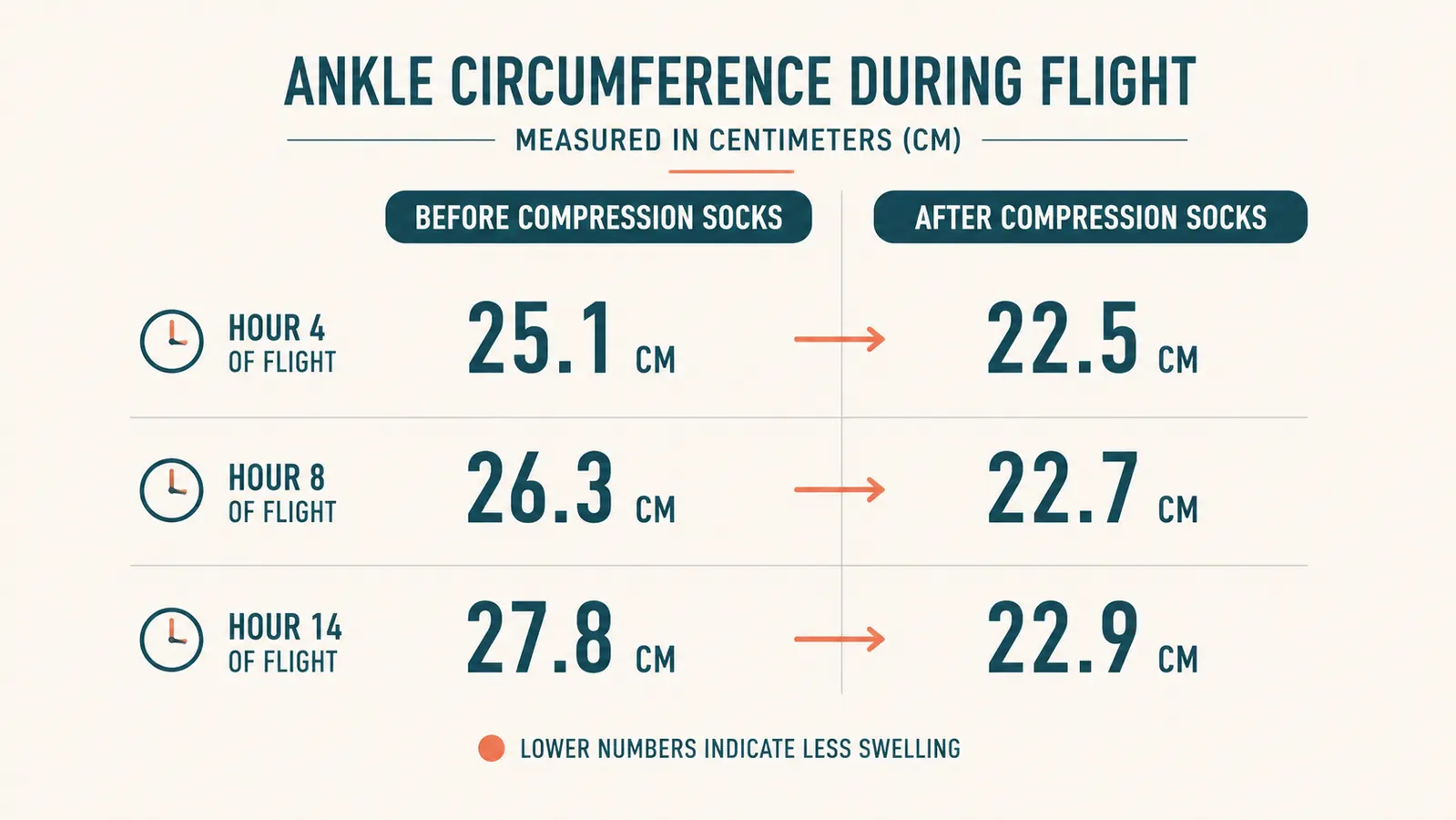
I did not measure my ankles with a tape measure before and after every flight. What I can tell you is that the puffiness I used to notice when I took off my shoes at the hotel was gone on every flight where I wore these, including the transatlantic. My legs also felt less heavy during the flights, which I noticed most on the second leg of a connection when I would normally be fighting the urge to stand up every 30 minutes.
What the Compression Actually Does for Long Flights
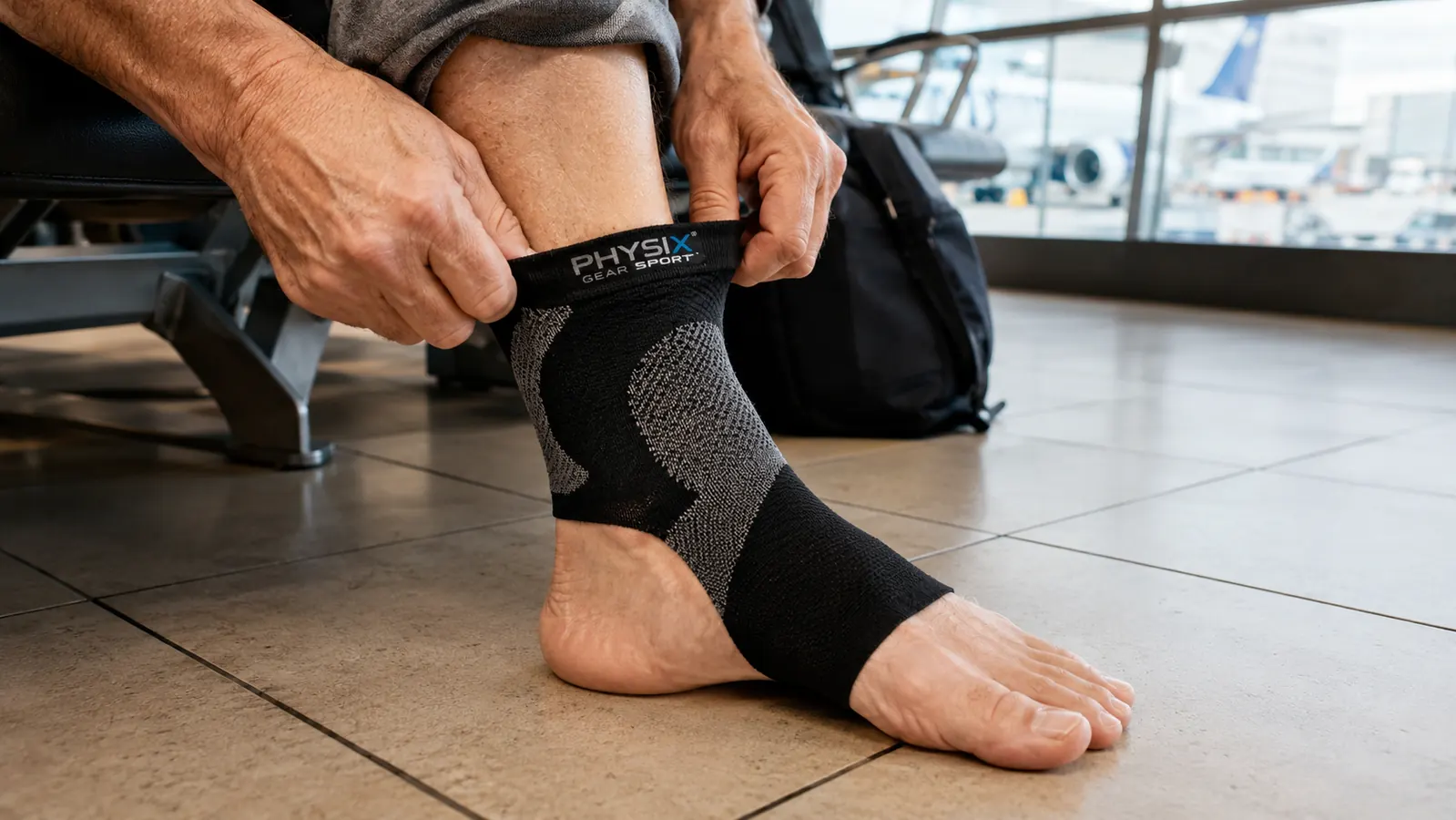
When you sit for hours at altitude, blood tends to pool in the lower legs because your calf muscles are not pumping it back up the way they do when you walk. The result is the swollen, stiff ankles and feet that long-haul flyers know well. Graduated compression socks apply the most pressure at the ankle and gradually less pressure up the calf, which assists venous return, the process of blood moving back toward the heart. The 20-30 mmHg range that Physix Gear uses is considered the moderate-compression therapeutic range.
If you have a diagnosed circulation condition, varicose veins, or any vascular issue, consult your doctor before using 20-30 mmHg socks. This compression level is higher than the casual 15-20 mmHg range and, in some cases, a different pressure or a medical-grade option may be more appropriate. For healthy travelers who just want to land feeling better, these are well within the standard recommendation.
On my flights wearing the Physix Gear socks, the difference was most noticeable in two ways. First, the heavy, fatigued feeling in my calves was much reduced even on the longest flights. Second, when I took my shoes off at the hotel, there was no visible indentation from my sock cuffs, which used to be my usual sign that my ankles had swelled and then slowly compressed back down. I am not going to tell you these socks eliminated all fatigue or that I bounded off a 14-hour flight feeling fresh. That is not realistic. But they made a noticeable, consistent difference.
I used to take my shoes off at the hotel and find red compression rings from my regular socks. That stopped happening. That is the whole review right there.
Build Quality and Compression Durability Over Six Months
The socks are a nylon-spandex blend with a cushioned footbed and a seamless toe. The outer fabric is smooth rather than ribbed, which means they slide into shoes and boots without bunching. That matters on a motorcycle, where I wear ankle-high riding boots and have had lesser compression socks bunch painfully around the ankle by mile 50.
After roughly 30 washes across two pairs, the compression is still intact. I tested this by putting them on a few months in and comparing the feel to a freshly opened pair I bought for a friend. The older pair is slightly softer but still noticeably compressive, not floppy like a worn-out athletic sock. The elasticity in the ankle band, which is the area that tends to go first on cheaper compression socks, is still firm. I wash them in cold water and hang them to dry, which I would recommend regardless of the care tag instructions.
The toe and heel reinforcement held up without thinning, which is better than I expected at this price point. I have had compression socks from other brands develop holes at the heel within 10 washes. These have not done that.
The Sizing Problem Worth Knowing About
Here is where I have to be honest about the main frustration. Physix Gear sizes by shoe size, not calf circumference, and calf circumference is what actually determines whether a compression sock fits correctly. I have a size 11 foot but a relatively narrow calf for my height. The large fit my foot fine but was slightly loose at mid-calf, which means the graduated compression was not as precise as it should be.
I have talked to other frequent flyers who had the opposite problem: normal shoe size but larger calves, and the socks felt too tight and left marks. If you have calves significantly larger or smaller than average for your shoe size, you may want to look at brands that size by actual calf measurement. That said, for most people with average proportions, the shoe-size system works fine, and the vast majority of those 95,000 reviewers clearly found a good fit. Just be aware going in.
Compression Socks on a Motorcycle: An Unexpected Use Case
I did not set out to test these on a motorcycle, but when I was packing for a three-day run through southern Utah and northern Arizona, I figured I would throw on the Physix Gear socks instead of my usual riding socks to see what happened. Six hours in the saddle is physiologically similar to six hours in an airplane seat: minimal leg movement, blood pooling, and the calf muscles barely doing their job.
The results were similar to the flight results. Less leg fatigue at the end of a long day. I stopped once in the afternoon to take them off because I thought the tightness was bothering me, and within an hour my calves felt noticeably heavier. Put them back on for the last stretch and the fatigue cleared up again. That convinced me more than any single flight test. On the boat they are less useful because I am on my feet and moving all the time, which naturally keeps blood circulating. They work best when you are stationary for extended periods.
What I Liked
- Noticeably reduces ankle swelling and leg fatigue on flights over four hours
- Compression holds up well after 30 or more wash cycles
- Smooth outer fabric that does not bunch inside shoes or riding boots
- Graduated 20-30 mmHg compression at a price that makes keeping two pairs easy
- Nearly 95,000 reviews suggest the fit works for most proportions
- Cushioned footbed adds comfort on long travel days
Where It Falls Short
- Sizing by shoe size only, not calf circumference, means fit varies for people outside average proportions
- Putting them on requires effort, especially early in the morning before a flight
- Not the most attractive sock if you care about that, the compression ridges are visible
- The aggressive compression can feel uncomfortable the first few times you wear them
How They Compare to What I Used Before
Before Physix Gear I cycled through two other compression sock brands, neither of which I will name here because I do not have fresh pairs to test against. One was a pharmacy brand that came in a medical-looking white with yellow toes that I absolutely refused to wear outside a hospital setting. The compression on those was good but they lost their elasticity after about 15 washes. The other was a name I found on a travel gear blog, ran about three times the price of Physix Gear, felt great the first few trips, and then the toe seam started separating at wash 12.
Physix Gear sits at the practical middle ground. Not the premium experience of a medical-grade sock, but far more durable than the cheap pharmacy options and significantly cheaper than the high-end travel brands. If you want a full comparison against a direct competitor, I have also put time into testing the CHARMKING compression socks in the same conditions. See that head-to-head in my Physix Gear vs CHARMKING comparison.

Who This Is For
These are the right socks for travelers who regularly take flights over four hours and who have noticed ankle swelling, leg fatigue, or that dead-legged feeling by the time they land. They are particularly useful for anyone over 40, since circulation naturally becomes less efficient with age, and for travelers who sit in economy class where you cannot get up and walk as freely as you might like. They are also a good call for anyone who drives long distances or sits for extended periods on road trips.
If you have been skeptical of compression socks because they seemed like a medical product for older people, I understand the instinct. I was there too. The reality is that they are a practical tool for anyone who spends long hours in a sitting position without much lower-leg movement. The 10 reasons to wear compression socks on your next flight piece I wrote covers the physiology in more detail if you want the longer version before you commit.
Who Should Skip It
If you have an existing vascular condition, peripheral artery disease, or severe edema, these are not the right starting point. Talk to your doctor first, because 20-30 mmHg is a meaningful pressure level and not appropriate for all conditions. People with calves significantly outside the average range for their shoe size may also find the fit inconsistent enough to reduce the effectiveness. And if you only take short flights, occasionally, the benefit is minimal enough that you probably do not need them.
Nine flights in. Still wearing them every time. Check the current price below.
Physix Gear compression socks have held up through months of regular use and consistent washing. At this price, keeping two pairs in your travel kit is an easy call.
Amazon Check Today's Price on Amazon →