
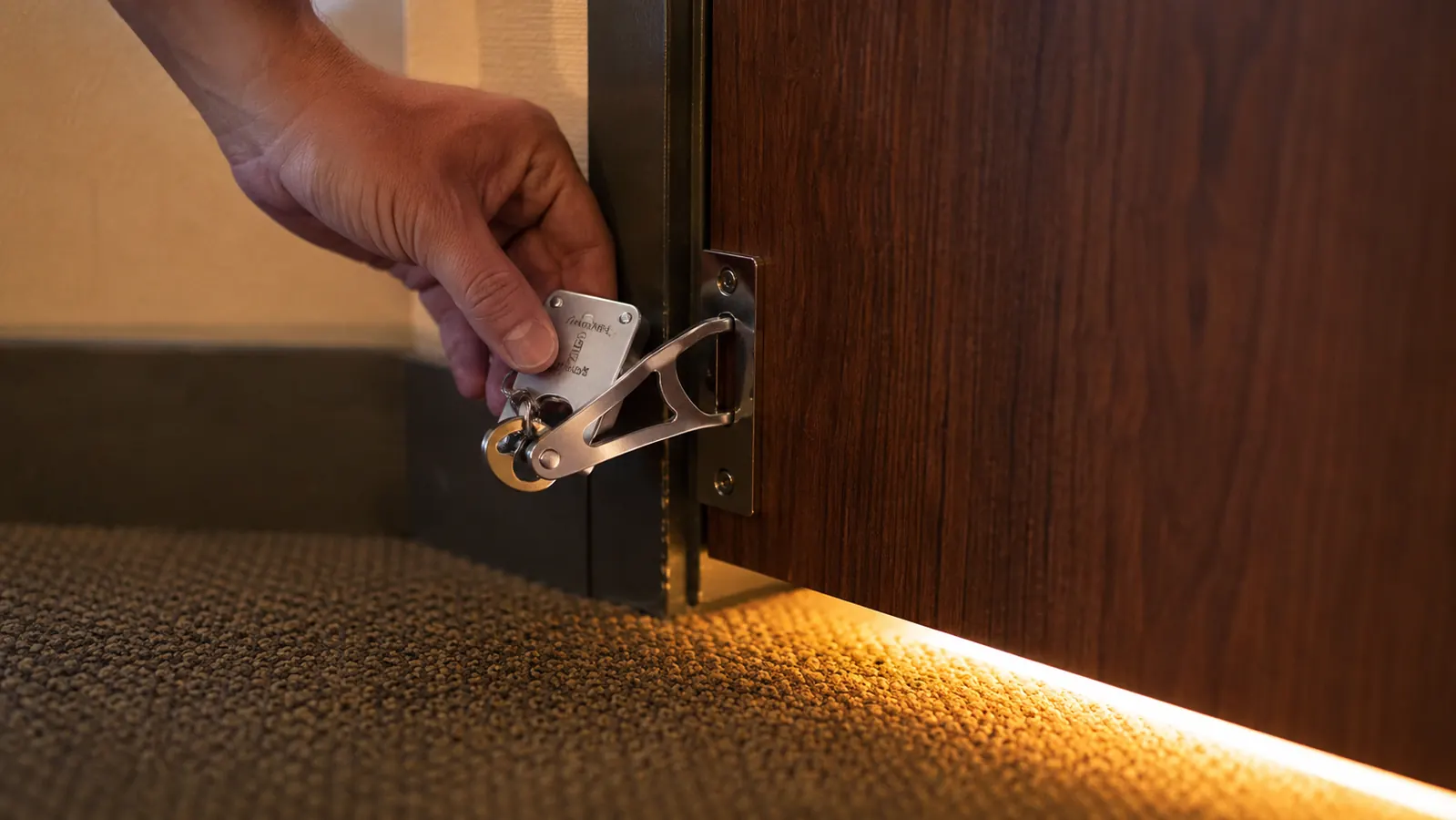
Let me tell you what nobody writes in the glowing five-star reviews. The Addalock is a good piece of gear. I carry one. I have carried one for going on four years, through budget hostels in Southeast Asia, a string of roadside motels on a cross-country motorcycle run, and a couple of sketchy marina-town guesthouses where I was fairly sure the front desk attendant had a copy of every key in the building. But this device has hard limits that its fans conveniently skip over, and if you buy it without understanding those limits, you are going to find out the hard way at midnight in an unfamiliar city.
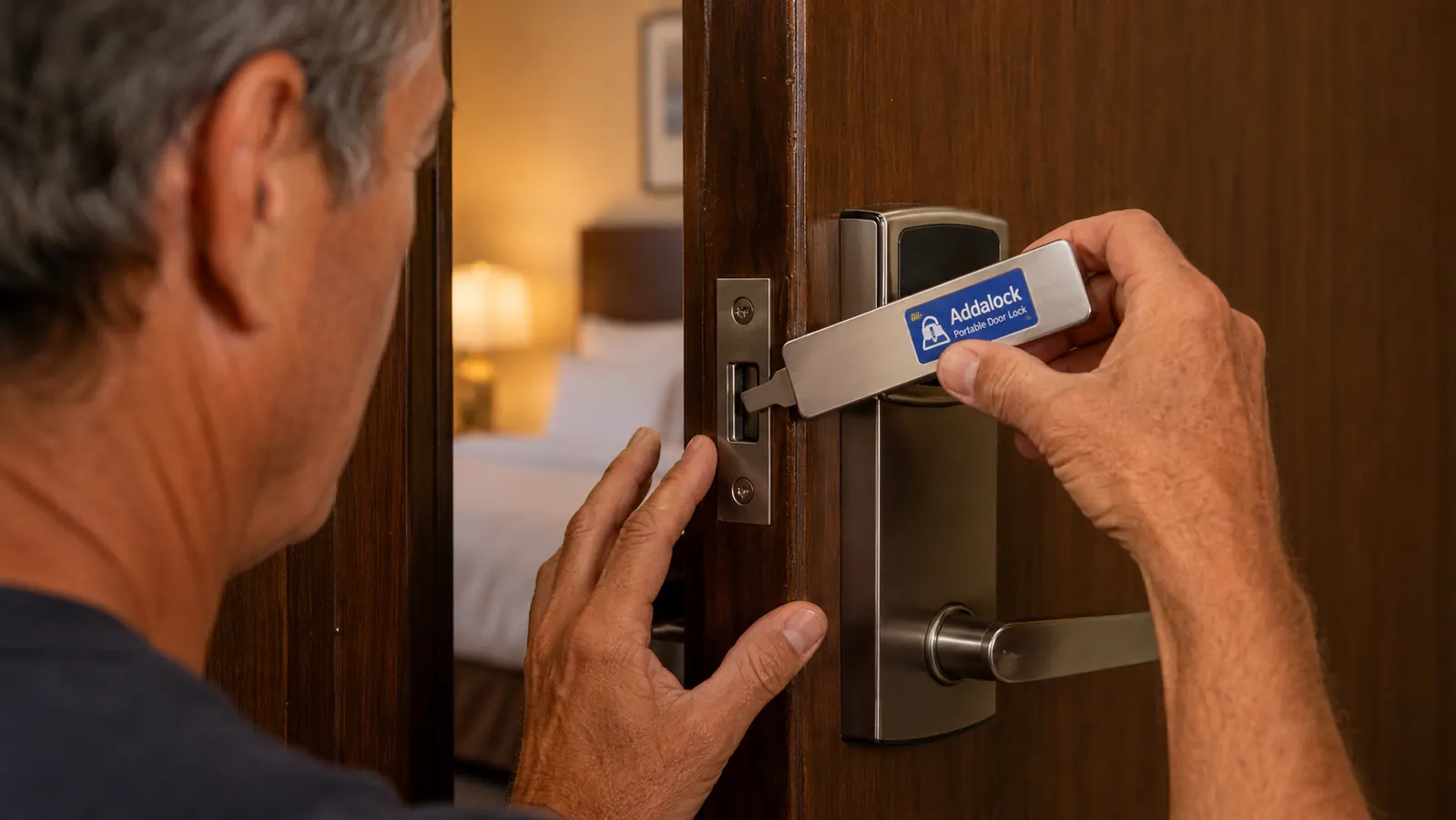
The Addalock is a single-piece forged aluminum bar with two prongs. One prong slides into the gap between the door latch face and the strike plate opening in your door frame. The other anchors behind the door edge itself. When someone pushes from the hallway, the device uses the door frame as a brace and the geometry locks up solid. There are no moving parts, no batteries, no codes, and nothing that requires a signal. It fits in a coin pocket and weighs almost nothing. When it works, it is genuinely hard to defeat from outside.
The Quick Verdict
Excellent on the right door, useless on the wrong one. Know your door type before you trust your sleep to it.
Amazon Check Today's Price →If your hotel door swings inward and has a standard strike plate, this is the cheapest reliable backup lock you will find.
The Addalock has more than 18,000 reviews and a 4.4 rating for a reason. Check today's price on Amazon and see if it fits your travel setup.
Amazon Check Today's Price on Amazon →How I Have Actually Used It
I started carrying the Addalock after a stay at a budget guesthouse in Chiang Mai where the deadbolt had been repaired so many times that the bolt no longer aligned with the strike plate properly. It turned when you twisted the knob, but it did not actually seat. I jammed a chair under the door handle that night. When I got home I ordered the Addalock and have not traveled without it since. That single bad night cost me four hours of sleep I never got back.
Over four years I have been able to use it successfully in roughly seven out of ten rooms I have tried. That is my honest number. Three out of ten rooms either had outward-swinging doors, European-style handle-set plates with no accessible gap, or strike plate openings that were too shallow or oddly shaped for the device to seat. In those rooms I relied on the chain lock if there was one, or the rubber door wedge I also carry as a backup. Understand that going in: this is a great tool for most American hotel rooms, many budget accommodations in Asia and Central America, and some Airbnbs, but it is not a universal solution and you should not pack it expecting otherwise.
On the motorcycle run last fall, I was staying at whatever motel had a vacancy sign lit. Most of those rooms had standard inward-swinging doors with wide strike plate gaps. The Addalock seated perfectly every time, and I slept better knowing that even if someone had a master key, the bar was blocking the throw. That peace of mind matters when you have your riding gear and your laptop in a room you have never been in before and will not be in again.
The Mechanical Reality: Where It Works and Where It Does Not
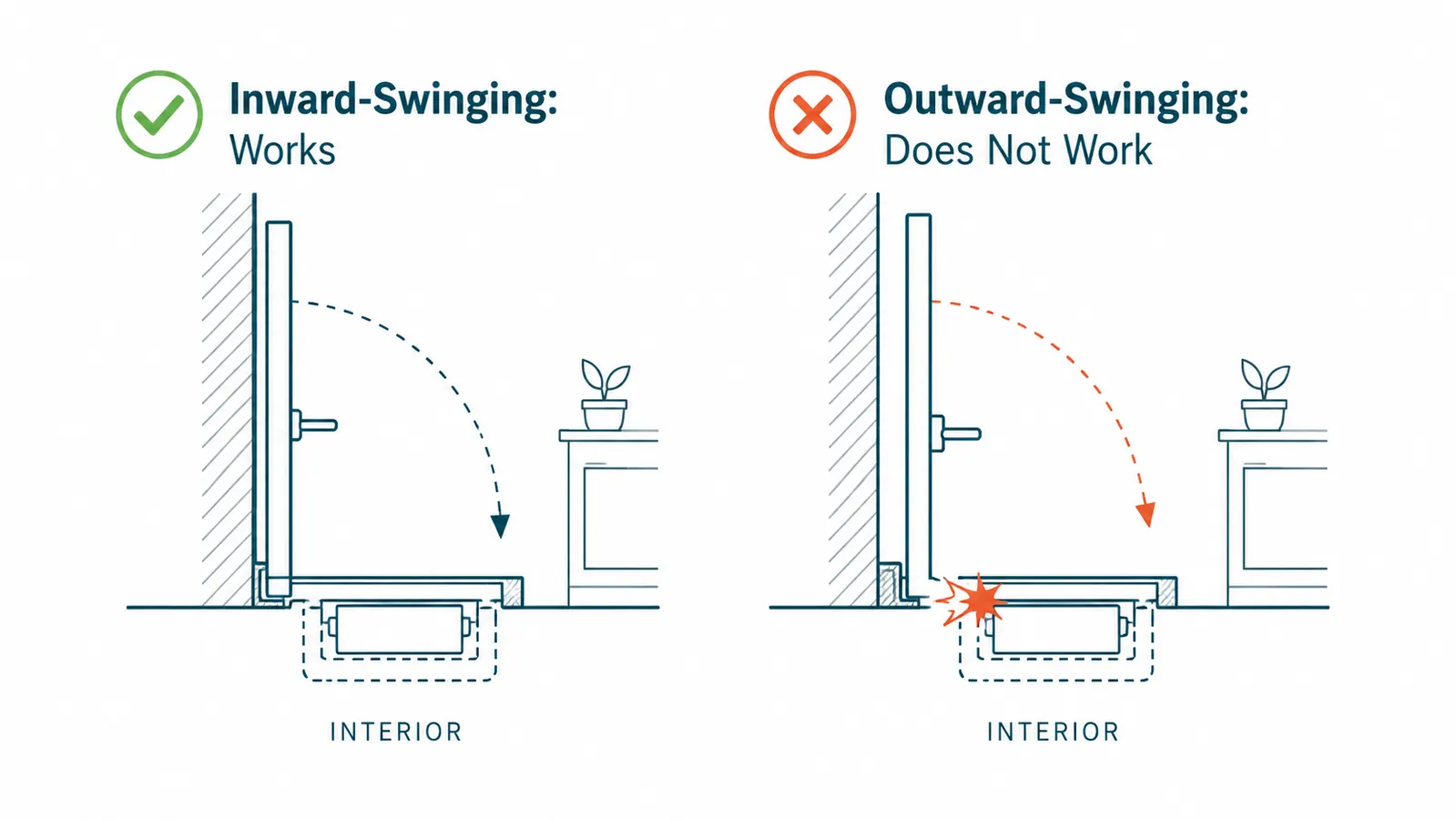
The Addalock needs three things to function: the door must swing inward, there must be a gap between the latch face on the door and the strike plate opening in the frame, and that gap must be wide enough for the prong to slide in. If any one of those conditions is absent, the device cannot work at all. This is not a flaw in manufacturing. It is a constraint of the design, and the company is upfront about it if you read the product description carefully.
Outward-swinging doors are a complete dead end. If the door opens away from you into the hallway, the strike plate geometry is reversed and there is no way to brace the bar against anything. European hotels use outward-swinging doors more commonly than American ones. Some newer commercial properties in the US are built the same way for fire-egress code reasons. I have encountered outward-swinging doors at roughly 30 percent of the international properties I have stayed at. Check which way your door swings before you unpack and before you decide you are protected for the night.
The second failure case is the door frame gap. On older doors the gap between the latch face and the strike plate is wide and obvious. On some newer commercial doors, the strike plate is mortised flush with the frame and the gap is nearly nonexistent. The Addalock prong simply cannot get purchase. You can tell in about five seconds whether this is your situation: try to insert a credit card edge into the gap where the latch meets the frame. If the card cannot slip in, the Addalock will not seat either.
There is also a secondary issue some users report: on doors where the gap is near the minimum, the device can seat but feels slightly loose. It still functions as a barrier, but it does not have the solid rigidity you get on a well-fitted door. In that situation I still use it, and I fold a small piece of paper or a card behind the bar to take up slack. It sounds improvised because it is. It works.
Seven out of ten hotel rooms. That is my honest success rate after four years. Good enough to carry it every trip. Not good enough to skip packing a backup wedge.
Build Quality: What Fifteen Years of the Same Design Tells You
The Addalock has not changed much since it first appeared on the market. That is either a sign of lazy product development or a sign that the designers got it right the first time. I lean toward the latter. The device is machined aluminum with an anodized finish. It does not flex, does not rattle, and has nothing that can break. My four-year-old unit looks and functions exactly like a new one. If you want to see how it stacks up against the SABRE model on specific specs and installation feel, see our Addalock vs SABRE portable door lock comparison.
Compare that to plastic-bodied competitors at half the price. I have seen those crack at the hinge point after a year of being stuffed into a travel bag. The Addalock will outlast your luggage. For a piece of gear you are trusting with your physical security, the durability argument is not a minor point. It is the whole point.
The Deadbolt Confusion: What This Device Actually Is
Here is the framing mistake that burns people. A lot of travelers buy this expecting it to replace the deadbolt. It does not replace the deadbolt. It is a secondary latch that prevents the door from being pushed open even if someone has a key or manages to defeat the primary lock. The deadbolt is still your first line of defense. The Addalock covers the gap between what the hotel's hardware provides and what you actually need to sleep without one ear open all night.
If your hotel room has a functioning deadbolt, a properly installed chain lock, and a working door viewer, you probably do not need additional security for most destinations. Where the Addalock earns its place is the room where one of those elements is missing or compromised, which in budget accommodations is not rare. The deadbolt that spins without engaging. The chain that was ripped off and screwed back in with a single short screw that pulls free under pressure. These are the scenarios where an independent physical brace matters most.
It is also worth being direct about force resistance. The manufacturer does not publish burst-force numbers, and the Addalock is not rated to a specific load. Based on the physics of the design, a very determined person throwing sustained body weight against the door could eventually defeat it. What it reliably stops is casual unauthorized entry: a master key, a card shimming the latch, or a slow steady push from someone testing whether the room is secured. That covers the realistic threat in the vast majority of travel situations. For a broader picture of what else you can do, the guide on how to secure your hotel room door walks through the full layered approach.
Installation Reality: How Fiddly Is Fiddly?
The Addalock takes about ten seconds to install once you know the motion. The learning curve is understanding the angle. You tilt the long prong into the strike plate gap at roughly 30 degrees, then rotate the bar flat against the door so the short prong seats behind the door edge. Done. On your first few tries you will probably fumble it. The gap is narrower than it looks and the prong has to hit a specific pocket inside the strike plate housing.
Practice at home before your first trip. Find a door in your house with a standard strike plate and run through the installation five or six times until it feels automatic. You do not want to be working out the hand position at 11pm in a dim hotel room after a long travel day. Once the motion is in muscle memory it is genuinely fast, and you can do it without turning the lights on. Removal is even faster: rotate the bar back to the angled position and it slides free.
One note for travelers who need glasses for close work: the interior pocket where the prong seats is not visible during installation. You are doing this by feel, not by sight. Keep your glasses on, or accept that you are navigating entirely by touch. Both work fine once you have practiced, but knowing that ahead of time removes the frustration on night one.
What I Liked
- Machined aluminum, virtually indestructible under normal travel use
- Weighs under 2 ounces and fits in a coin pocket or small toiletry bag
- No batteries, no codes, no app, nothing to fail electronically
- Strong secondary barrier on properly fitted inward-swinging doors
- Fast removal from inside in any emergency, including fire
- More than 18,000 reviews validate real-world reliability across years of use
- Entirely independent of the hotel door chain, which is often flimsy or damaged
Where It Falls Short
- Completely incompatible with outward-swinging doors, which are common in Europe
- Will not seat on strike plates with minimal or flush-mortised gaps
- Takes several practice runs before installation feels smooth
- No independently published force-resistance rating
- Does not work on sliding doors, pocket doors, or frameless glass doors
- Real-world success rate is roughly 7 in 10 rooms, not every room

Who This Is For
The Addalock is the right tool for solo travelers who move through a mix of budget to mid-tier properties, particularly in North America, Central America, and parts of Southeast Asia where inward-swinging doors with standard strike plates are the norm. It also suits anyone whose primary concern is unauthorized key entry rather than a forced physical breach. If you stay at higher-end hotels where deadbolts are solid and security standards are enforced, you may never need it. If you stay at properties like the ones I cycle through on long trips, you will use it every single time.
It is especially practical for motorcycle travelers, road trippers, and overlanders who cycle through a lot of roadside properties quickly and do not want to think hard about security every night. The weight and pack size are genuinely negligible. Adding the Addalock to your kit is not a tradeoff against anything else. I carry it alongside a thin rubber door wedge for the rooms where the Addalock will not seat. Both together weigh less than a deck of cards, which is exactly what you want from a security layer that lives in your bag full-time.
Who Should Skip It
Skip the Addalock if you primarily travel in Western Europe. Outward-swinging doors and mortised strike plates are common enough there that your success rate will be significantly lower than what I see in North America and Asia. A rubber door wedge or a door-stop alarm works better in those environments because neither depends on strike plate geometry.
Also skip it if you need fortress-level protection. This is a deterrent and a barrier against casual unauthorized entry. It is not a rated security product and it will not stop a sustained, forcible breach attempt. If your threat model requires that level of assurance, you need accommodations with better baseline security, not a travel accessory. But for the traveler who just wants to sleep without worrying about a master key slipping the latch, it does exactly that job well and has done it for 15 years.
Four years in my kit and it stays there. Here is where to check today's price.
At its current price on Amazon, the Addalock costs less than a single night in most of the properties it protects you in. For the 7 out of 10 doors it fits, there is nothing better at this size and weight. Check the current price and read through the 18,000-plus real buyer reviews before you decide.
Amazon Check Today's Price on Amazon →